
Managing spaces and sales between remote and on-site experiences
In events, shopping malls, and complex venues, space management is often split into two separate phases: first, when spaces are sold or assigned, and later, when they are used on-site.
This approach creates a gap between the commercial phase (pre-sale) and the operational phase (actual use of the space).
A 3D map with booking functionality introduces a different model. The space is represented digitally and becomes accessible both remotely, for selection and booking, and on-site, during actual use.
In this way, the same tool supports the entire cycle: from space selection to its real-world experience.
From space selection to operational management
Our 3D maps allow users to visualize, configure, and book spaces within a digital environment that replicates reality.
Users can:
- Explore spaces remotely, evaluating position, size, and context
- Customize booths, areas, or products in 3D using configurators to understand their real impact
- Directly book spaces, turning them into a digital inventory
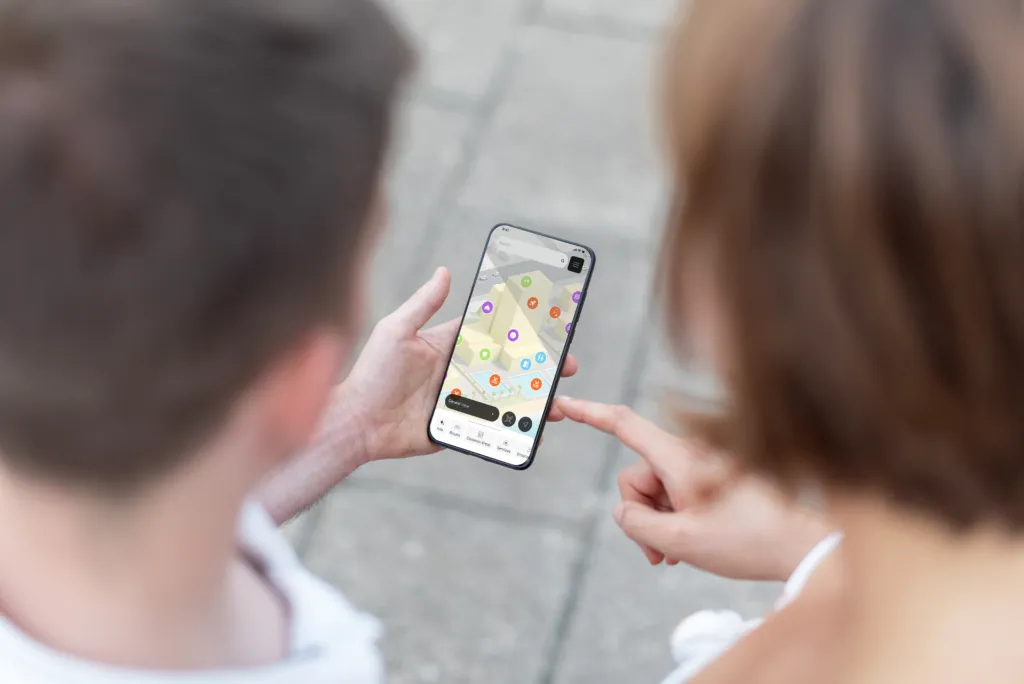
- Access the same map on-site during events or visits
The key value is continuity between phases:
the space does not switch tools between before and after, but remains the same updatable digital environment.
How it works: from 3D model to remote and on-site usage
The system is based on a simple structure that connects representation and usage.
Phase 1: space modeling
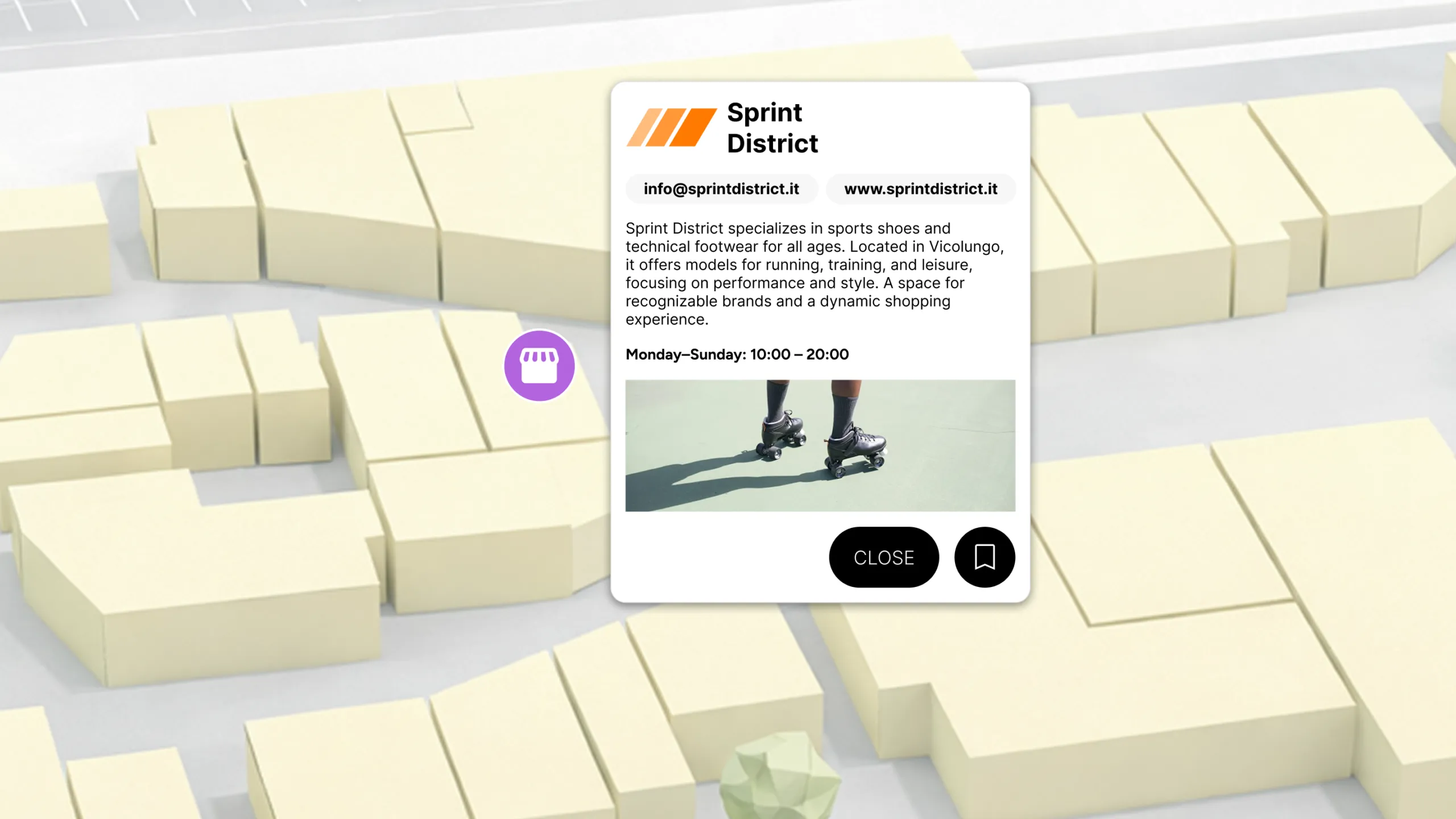
The space is reconstructed in 3D, including areas, services, and points of interest.
Phase 2: configuration and activation
Each area can be:
- made bookable
- visually customized
- connected to content or information
Phase 3: dual-level usage
- Remote: users, brands, or companies explore, evaluate, and book spaces
- On-site: the same map is used during the event via mobile devices or digital kiosks
This enables a shift from separate management to continuous space management.
Connecting commercial phase and real space usage
The limitation of traditional approaches is the separation between sales and usage.
Decisions are made without a concrete spatial understanding, and the on-site experience is disconnected from the selection phase.
The 3D map with booking introduces a single unified system that delivers value on multiple levels:
- For buyers or exhibitors: clearer decisions thanks to realistic space visualization
- For organizers and managers: centralized control of spaces, content, and availability
- For brands: the ability to design and preview their presence in advance
- For on-site experience: continuity between what was selected and what is experienced
The result is a space that is more understandable, organized, and usable, both before and during the event.
Industries where pre-sale and usage come together
This solution applies to industries where space has both commercial and operational value, and is used by multiple stakeholders:
- Trade fairs and events
Exhibitors can select and configure booths remotely and experience the same setup during the event. - Shopping malls
Brands and retailers can book temporary spaces and manage their presence before and during activation. - Stadiums and arenas
The map enables seat or area booking and supports the on-site experience. - Airports
Commercial spaces and services can be coordinated between planning and real-world usage. - City-wide events
Locations are explored and selected remotely but remain connected throughout the on-site experience.
Across all these contexts, the common need is to connect selection, management, and real use of space.
Transform your space with a 3D map
The integration of 3D maps and booking systems removes the separation between pre-sale and real-world usage.
The space becomes a continuous digital environment, accessible before, during, and after activation.